In Hester v. State Farm Fire & Casualty Co., 2025 U.S. Dist. LEXIS 174539 (M.D. Tenn. Sept. 8, 2025), the Middle District of Tennessee declined to take a disputed roof‑replacement case away from a jury, holding that factual questions remain when an insurer insists repairs can be made with “matching” shingles and the policyholder presents evidence they cannot.

The case arose from a March 2023 wind event that damaged the Hesters’ roof in Clarksville. State Farm acknowledged wind damage and estimated the loss at just over $9,300, based on an assessment that approximately 67 shingles were damaged and could be repaired using GAF Timberline HDZ shingles in a “Barkwood” color. Relying on an ITEL report, State Farm concluded those shingles constituted an acceptable match and declined to replace the roof.

The Hesters disagreed. Their roofing consultant concluded that the proposed shingles would not match the existing roof in color, texture, or granulation and that partial repairs would leave the roof visually and functionally inconsistent. Based on that assessment, the insured’s consultant recommended full roof replacement at a cost exceeding $46,000.

State Farm moved for summary judgment, arguing that the policy’s “repair or replace” language gave it discretion to choose repair and that it had complied with the contract as a matter of law. The court rejected that framing. While Judge Crenshaw agreed that the policy does not require replacement in every case, the court emphasized that the dispute was not about contractual discretion in the abstract. The question was narrower and factual in nature: whether State Farm’s proposed repair actually satisfied the policy’s requirement of “similar construction and same use.”

On that point, the evidence conflicted. State Farm offered proof that matching shingles were available and suitable. The Hesters offered proof that they were not. That conflict, the court held, creates a genuine issue of material fact that must be resolved by a jury. Viewed in the light most favorable to the policyholders, a reasonable factfinder could conclude that repair was not reasonably achievable and that State Farm breached the policy by refusing to pay for replacement.

There were two other important parts of this decision. First, State Farm itself conceded that its policy requires matching. The court noted that State Farm argued “that the Policy requires ‘a full roof replacement . . . only when repairs cannot be reasonably completed with matching materials.’” In other words, at least in this case, State Farm agreed that matching is required—the dispute was whether matching was actually achievable. 

Second, Judge Crenshaw also declined to dismiss the Hesters’ punitive-damages claim, holding that the facts presented were sufficient to allow a jury to conclude that State Farm acted recklessly.  The court explained that “a jury could find that State Farm may have acted recklessly in refusing to replace the Hesters’ roof if there were no shingles that actually ‘matched.’”

This decision is a reminder of a couple of important principles. Absent policy language to the contrary, matching is required, a point that State Farm itself did not contest. Additionally, a carrier’s reliance on an ITEL report is not a “get out of jail free” card when it comes to punitive damages. This opinion makes clear that an insurer cannot blindly rely on an ITEL report to justify a repair-only position when the insured presents competent evidence to the contrary. If it does, the question of whether punitive damages are appropriate will be one for the jury to decide.

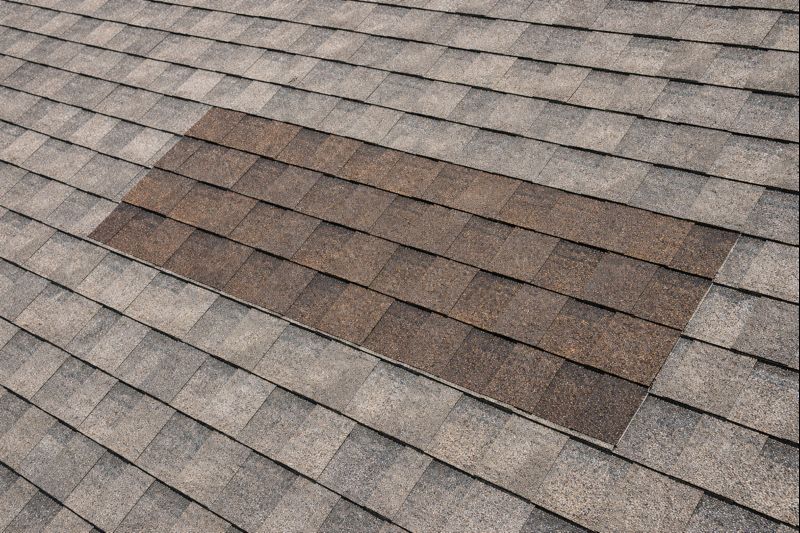
Matching continues to be an issue we deal with regularly, and its not always as obvious as what is reflected in the exemplar photograph above (which is an example only and is not a photograph of the Hesters’ roof). But, this case should help eliminate some disputes moving forward.

Happy holidays everyone!

Print:
Email this postTweet this postLike this postShare this post on LinkedIn
Photo of Brandon McWherter Brandon McWherter

J. Brandon McWherter is a Nashville-based lawyer and member of McWherter Scott & Bobbitt PLC, which has offices across the State of Tennessee and elsewhere across the Southeast.  Licensed in Tennessee, Arkansas, Mississippi, and numerous federal courts, he has dedicated his practice…

J. Brandon McWherter is a Nashville-based lawyer and member of McWherter Scott & Bobbitt PLC, which has offices across the State of Tennessee and elsewhere across the Southeast.  Licensed in Tennessee, Arkansas, Mississippi, and numerous federal courts, he has dedicated his practice to assisting insurance policyholders with their claims against insurance companies, including claims for bad faith.

For well over a decade, McWherter’s practice has been focused almost exclusively on the prosecution of first party property insurance claims for policyholders.  His interest in this area of the law first started around 2003 when a tornado struck Jackson, Tennessee, where he lived and worked at the time.  Since then, McWherter has represented hundreds or thousands of policyholders whose claims have been underpaid or denied.  He advises and advocates for owners of commercial properties, industrial facilities, residential properties, churches, business owners, and other insurance policyholders.

Since he started counting in 2013, McWherter has assisted his clients in obtaining well in excess of Two Hundred Fifty Million Dollars ($250,000,000) in settlements, awards, and jury verdicts against insurance companies.

In 2018, McWherter was inducted as a fellow in the American College of Coverage Counsel, which is an invitation-only organization designed to facilitate and encourage the association of lawyers who are distinguished for their skill, experience, and high standards of professional and ethical conduct in the practice or teaching of insurance coverage and extra-contractual law and who are dedicated to excellence in this area of practice.

McWherter has been featured as a “Super Lawyer” or “Rising Star” by SuperLawyers every year since 2010.  Since 2013, he has been selected each year  for inclusion in U.S News and World Reports’ The Best Lawyers in America in the field of Insurance Law.  He also enjoys an AV Preeminent ranking by Martindale-Hubbell for legal ability and ethical standards.

Mr. McWherter is a lifelong Tennesseean and received his law degree from the University of Memphis. While in law school, he was a member of the University of Memphis Law Review, and served on the Editorial Board as Notes Editor.

In advocating for clients, McWherter has trudged through fire scenes and crawled storm-damaged roofs, quizzed consulting construction experts and experts for hours on end, and deposed and cross-examined hundreds of adjusters, experts, consultants, and other professionals within the insurance industry.  He reads insurance policies nearly every day and has a working knowledge of the customs and practices of insurance companies in investigation, estimating, and payment of claims.  McWherter counsels clients on presentation of claims, assists in compiling the evidence necessary to validate the amounts owed, and then enforces his clients’ rights, if necessary, via the judicial system and other alternative dispute resolution options, such as appraisal.

Several of McWherter’s cases have developed the law governing insurance disputes in the State of Tennessee, most recently including the Tennessee Supreme Court’s 2019 decision in Lammert et al. v. Auto-Owners Ins. Co., which held that insurers may not depreciate the costs of labor in determining their actual cash value payment obligations when the policy does not clearly allow it.

When not working, you will usually find Mr. McWherter with his wife, Angela, and his two daughters. He is an avid golfer and a lifelong bass fisherman, neither of which he does as often as he would like.

Practice Areas

  • Representation of policyholders in claims and litigation against insurance companies
  • Bad faith insurance litigation
  • Insurance-based consumer class actions

Professional Associations

  • Tennessee Bar Association
  • Arkansas Bar Association
  • Mississippi Bar Association
  • Tennessee Trial Lawyers Association
  • American Trial Lawyers Association (past member)
  • American Bar Association (past member)

Education

  • B.S.B.A. – Union University (1998)
  • J.D. – University of Memphis (2001)

Bar Admissions

  • Tennessee
  • Mississippi
  • Arkansas
  • Fifth Circuit Court of Appeals
  • Sixth Circuit Court of Appeals
  • Eleventh Circuit Court of Appeals
  • United States District Court for the Western District of Tennessee
  • United States District Court for the Middle District of Tennessee
  • United States District Court for the Eastern District of Tennessee
  • United States District Court for the Northern District of Mississippi
  • United States District Court for the Southern District of Mississippi
  • United States District Court for the Eastern District of Arkansas
  • United States District Court for the Western District of Arkansas
  • United States District Court for the Northern District of Illinois
  • United States District Court for the Central District of Illinois
  • United States District Court for the Southern District of Illinois
  • United States District Court for the Western District of Texas
  • United States District Court for the Eastern District of Michigan
  • United States District Court for the Western District of Wisconsin