
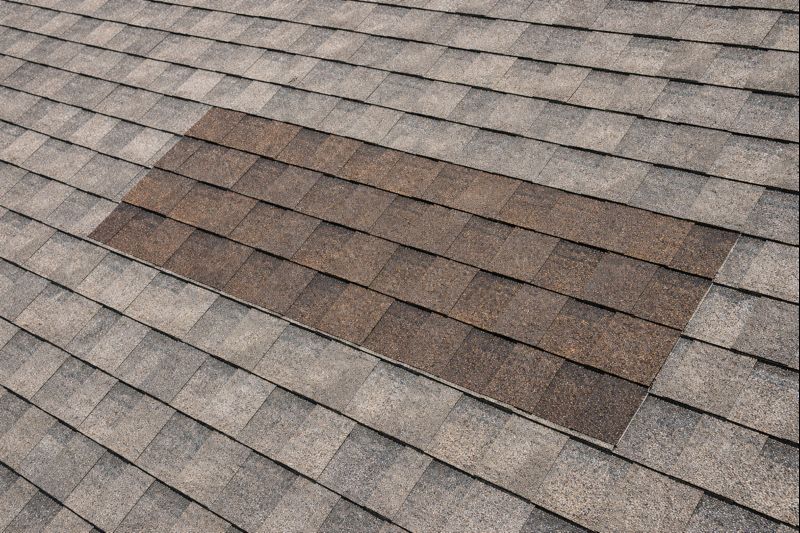
In Hester v. State Farm Fire & Casualty Co., 2025 U.S. Dist. LEXIS 174539 (M.D. Tenn. Sept. 8, 2025), the Middle District of Tennessee declined to take a disputed roof‑replacement case away from a jury, holding that factual questions remain when an insurer insists repairs can be made with “matching” shingles and the policyholder presents evidence they cannot.
The case arose from a March 2023 wind event that damaged the Hesters’ roof in Clarksville. State Farm acknowledged wind damage and estimated the loss at just over $9,300, based on an assessment that approximately 67 shingles were damaged and could be repaired using GAF Timberline HDZ shingles in a “Barkwood” color. Relying on an ITEL report, State Farm concluded those shingles constituted an acceptable match and declined to replace the roof.
The Hesters disagreed. Their roofing consultant concluded that the proposed shingles would not match the existing roof in color, texture, or granulation and that partial repairs would leave the roof visually and functionally inconsistent. Based on that assessment, the insured’s consultant recommended full roof replacement at a cost exceeding $46,000.
State Farm moved for summary judgment, arguing that the policy’s “repair or replace” language gave it discretion to choose repair and that it had complied with the contract as a matter of law. The court rejected that framing. While Judge Crenshaw agreed that the policy does not require replacement in every case, the court emphasized that the dispute was not about contractual discretion in the abstract. The question was narrower and factual in nature: whether State Farm’s proposed repair actually satisfied the policy’s requirement of “similar construction and same use.”
On that point, the evidence conflicted. State Farm offered proof that matching shingles were available and suitable. The Hesters offered proof that they were not. That conflict, the court held, creates a genuine issue of material fact that must be resolved by a jury. Viewed in the light most favorable to the policyholders, a reasonable factfinder could conclude that repair was not reasonably achievable and that State Farm breached the policy by refusing to pay for replacement.
There were two other important parts of this decision. First, State Farm itself conceded that its policy requires matching. The court noted that State Farm argued “that the Policy requires ‘a full roof replacement . . . only when repairs cannot be reasonably completed with matching materials.’” In other words, at least in this case, State Farm agreed that matching is required—the dispute was whether matching was actually achievable.
Second, Judge Crenshaw also declined to dismiss the Hesters’ punitive-damages claim, holding that the facts presented were sufficient to allow a jury to conclude that State Farm acted recklessly. The court explained that “a jury could find that State Farm may have acted recklessly in refusing to replace the Hesters’ roof if there were no shingles that actually ‘matched.’”
This decision is a reminder of a couple of important principles. Absent policy language to the contrary, matching is required, a point that State Farm itself did not contest. Additionally, a carrier’s reliance on an ITEL report is not a “get out of jail free” card when it comes to punitive damages. This opinion makes clear that an insurer cannot blindly rely on an ITEL report to justify a repair-only position when the insured presents competent evidence to the contrary. If it does, the question of whether punitive damages are appropriate will be one for the jury to decide.
Matching continues to be an issue we deal with regularly, and its not always as obvious as what is reflected in the exemplar photograph above (which is an example only and is not a photograph of the Hesters’ roof). But, this case should help eliminate some disputes moving forward.
Happy holidays everyone!